

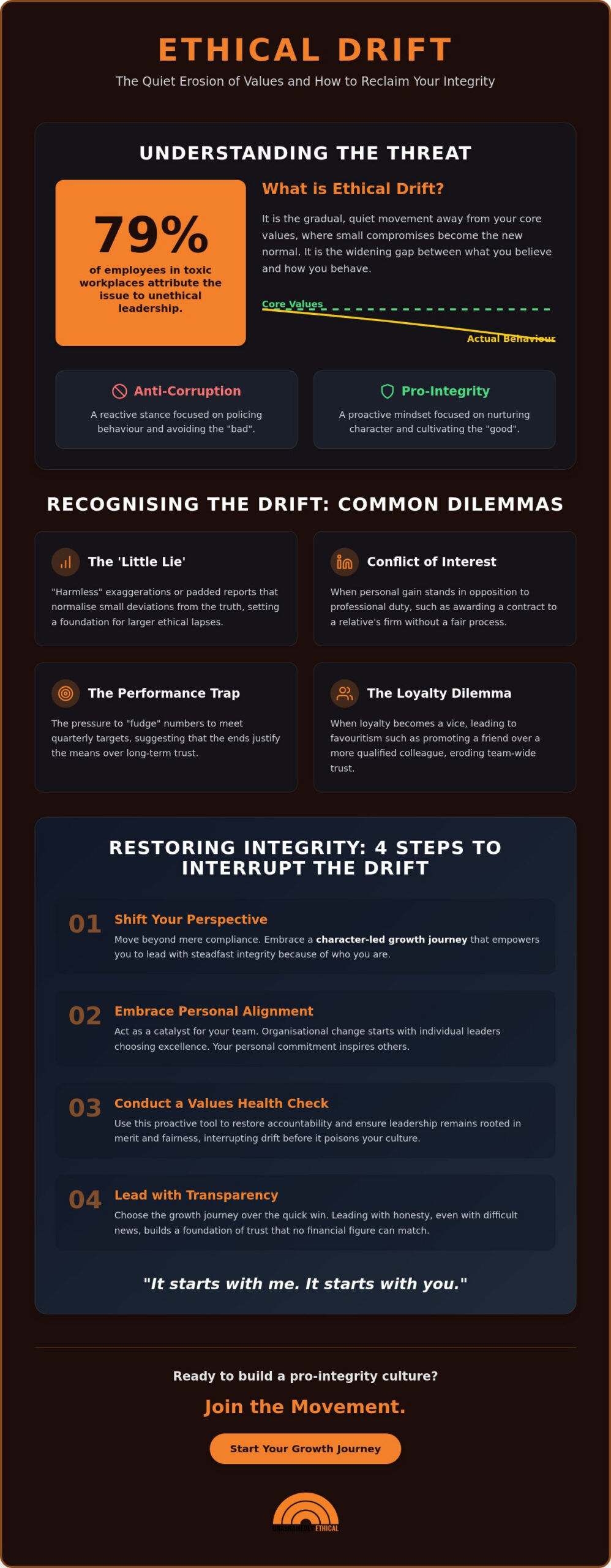
What if the most dangerous threat to your professional integrity isn’t a massive, headline-grabbing scandal, but a series of tiny, quiet compromises you make every Tuesday morning? It’s a sobering thought. Recent data indicates that nearly 79% of employees who experience a toxic workplace attribute the core issue to unethical or unaccountable leadership. You likely want to do the right thing, but the pressure to conform to “business as usual” can make your personal values feel increasingly eroded. It’s common to feel a sense of confusion when facing the gray areas of corporate life, especially when you fear the social cost of standing alone amongst your peers.
We believe that transformation is possible and that it starts with you. By examining real-world examples of ethical dilemmas in the workplace, you’ll learn to recognise the subtle signs of ethical drift before they spiral into a full-blown crisis. This article provides a practical framework to help you reclaim your character and lead with steadfast integrity. We’ll explore how character-led leadership can transform your professional environment, moving you from a state of quiet compromise to a bold growth journey where your values lead the way.
Key Takeaways
- Understand the mechanics of ethical drift and how the normalisation of compromise creates a quiet movement away from your core values.
- Examine practical examples of ethical dilemmas in the workplace to navigate the grey areas where the right choice isn’t always immediately clear.
- Shift your perspective from mere compliance to a character-led growth journey that empowers you to lead with steadfast integrity.
- Learn how to implement a pro-integrity culture using the Ethics in Action framework to transform your professional environment for the better.
Understanding Ethical Drift: Why Small Compromises Matter
True workplace ethics aren’t found in a dusty employee handbook or a compliance checklist. They live in the quiet moments between meetings and the split-second decisions made whilst under pressure. When we consider examples of ethical dilemmas in the workplace, we often imagine grand scandals or legal battles. Yet, the true danger lies in “ethical drift,” which is the quiet, unnoticed movement away from integrity where compromise becomes the new normal. Ethical drift is the gradual widening gap between what we value and how we actually behave in the office.
Adopting a pro-integrity mindset is far more transformative than a simple anti-corruption stance. Whilst anti-corruption focuses on avoiding the “bad,” being pro-integrity is about actively cultivating the “good.” It shifts the focus from policing behaviour to nurturing character. This approach creates a culture where excellence is the standard rather than a requirement. It’s about building a movement of people who are committed to doing the right thing because it aligns with who they are, not because they fear being caught.
This commitment to truth extends to how a company presents itself to the world; for example, using Trustify360 to gather and display genuine customer feedback ensures that a business’s reputation is built on verified honesty rather than curated marketing.
The Normalisation of the ‘Little Lie’
It often starts with a “harmless” exaggeration in a sales pitch or a slightly padded progress report to meet a quarterly target. These small deviations from the truth seem insignificant in the moment. However, they establish a foundation for larger ethical lapses. These moments are the primary battleground for your growth journey. Choosing honesty in the small things builds the moral muscle needed for the big ones. When we normalise the little lie, we lose our ability to recognise the larger drift.
It Starts With Me: The Power of Personal Alignment
Common Examples of Ethical Dilemmas in the Workplace
Confronting the reality of daily business requires more than just good intentions. It demands a clear-eyed look at the moments where our values are tested. These examples of ethical dilemmas in the workplace often manifest as a tension between short-term survival and long-term character. Whether you are a CEO of a large corporation or a mid-level manager in a smaller firm, the pressure to choose the path of least resistance is a universal experience.
Conflict of interest represents one of the most persistent grey areas. This occurs when personal gain, or perhaps the gain of a close associate, stands in direct opposition to your professional duty. It isn’t always about a massive bribe; it’s often the subtle choice to award a contract to a relative’s firm without a fair tender process. These moments aren’t just management hurdles. They are opportunities to prove that your commitment to a pro-integrity culture is more than just words on a website. To help your team find their way through these complexities, our Transformational Leadership on Demand platform provides a shared language that turns confusion into clarity.
The Performance Trap: Numbers vs. Values
Imagine being R500,000 short of a quarterly target that determines your team’s bonuses. You might feel a nudge to “fudge” the delivery dates or misrepresent a report to bridge the gap. This performance trap suggests that the ends justify the means. However, leading with transparency, even when the news is difficult, builds a foundation of trust that no financial figure can match. It’s about choosing the growth journey over the quick win. It starts with me. It starts with you.
The Loyalty Dilemma: Favouritism amongst the Team
Promoting a close friend over a more qualified colleague is a common struggle that erodes trust within a communal work environment. Whilst loyalty is a virtue, it becomes a vice when it leads to unfairness. You can use a Values health check to restore accountability and ensure that your leadership remains rooted in merit and fairness. This simple step interrupts the drift before it poisons your office culture. If you’re ready to start this process, you might want to explore our roadmap to corporate integrity today.
Restoring Integrity: Actionable Steps to Interrupt the Drift
Transformation requires a deliberate pivot toward excellence. We must move beyond mere compliance-based behaviour, which often feels like a burden, and embrace character-led leadership as a joyous, communal pursuit. When we encounter examples of ethical dilemmas in the workplace, they should serve as catalysts for growth rather than reasons for despair. By choosing to lead with conviction, you transform your professional environment into a space where integrity flourishes.
Initiating Your Personal Growth Journey
- Step 1: Practice Daily Reflection. Spend five minutes each evening examining your decisions to catch the subtle signs of drift before they become habits.
- Step 2: Start a Values Conversation. Engage your team in open dialogue to establish a shared ethical vocabulary that makes integrity the default setting.
- Step 3: Commit to a Character Development Programme. Enrol in a structured journey such as Transformational Leadership on Demand to strengthen your moral foundation.
Leading the Movement in Your Organisation
True systemic reform occurs when we institutionalise our values. By implementing the Ethics in Action Business Consultancy framework, your organisation can actively monitor and reinforce the principles that define its culture. This isn’t a punitive measure; it’s a proactive strategy to safeguard the health of your communal environment. It provides a structured roadmap to ensure that your values are lived out in every transaction.
We invite you to become a Values Champion within your sphere of influence. When you see examples of ethical dilemmas in the workplace, view them as opportunities to model a better way. Take a bold stand today by signing the Unashamedly Ethical NPC Commitment. This public signal of your dedication to clean living invites others to join this virtuous movement. Transformation isn’t a distant dream; it’s a series of courageous choices made in the present moment.
It starts with me. It starts with you.
Leading the Way to a Pro-Integrity Future
The journey toward a virtuous workplace begins with the courage to acknowledge that ethical drift is a reality for us all. We’ve explored how small, quiet compromises can erode our standards; we’ve also examined specific examples of ethical dilemmas in the workplace that test our character daily. By choosing to implement a pro-integrity mindset, you move beyond mere compliance and enter a growth journey rooted in shared purpose. This transformation isn’t just about avoiding misconduct; it’s about actively cultivating excellence in every interaction.
Since 2009, Unashamedly Ethical NPC has been dedicated to restoring values-based living across the globe. Through tools like Transformational Leadership on Demand (TLOD) for character formation and our Ethics in Action frameworks for values-driven organisations, we provide the structured support needed to institutionalise integrity. You don’t have to face these challenges alone. You belong to a larger community of values champions committed to systemic reform and personal accountability.
Take the next step in your leadership journey today. We invite you to sign the Unashamedly Ethical NPC Commitment and join our global movement for integrity. Together, we can interrupt the drift and build a professional landscape where honesty is the standard. It starts with me. It starts with you.
Frequently Asked Questions
How do I handle an ethical dilemma when my manager is the one involved?
You handle an ethical dilemma involving a manager by choosing a path of respectful transparency and seeking support within your professional community. It’s helpful to document the situation clearly and frame your concerns around your organisation’s shared values rather than personal grievances. By engaging with a Values Champion or utilising established character development frameworks, you can address the issue with courage. Standing for excellence protects the integrity of the entire ecosystem. It starts with you.
What is the difference between a ‘grey area’ and ethical drift?
A ‘grey area’ represents a specific scenario where the right choice isn’t immediately obvious, whereas ethical drift is the gradual, quiet erosion of values over time. Whilst grey areas are common examples of ethical dilemmas in the workplace, ethical drift is the cumulative process where compromise becomes the new normal. Navigating a grey area requires careful discernment; interrupting drift requires a steadfast commitment to a personal growth journey and daily reflection.
Can one person really change the ethical culture of a large organisation?
Yes, a single individual acting with moral conviction can serve as a powerful catalyst for change, even in a massive organisation. When you choose to lead with character, you create a ripple effect that inspires your peers and challenges the standard of “business as usual”. This movement often begins when one person decides to live unashamedly, proving that a pro-integrity culture is both possible and infectious. One courageous voice can interrupt the drift for an entire department.
How do I align my personal values with a workplace that feels compromised?
You align your values by becoming a beacon of excellence and initiating small, transformative changes within your immediate sphere of influence. If the environment feels compromised, focus on your own character development and seek out like-minded colleagues to form a virtuous tribe. For experienced real estate investors and entrepreneurs, joining an elite group like The Boardroom Mastermind can provide the high-level peer support needed to maintain these standards. By conducting a values health check on your daily actions, you ensure your integrity remains intact whilst you work to inspire a broader culture shift. Your personal alignment is the first step toward systemic reform.

Article by
Ilene Power
Ilene Power is the Chief Operating Officer and Ethics Officer of Unashamedly Ethical NPC, a South African organisation and global movement promoting ethical leadership, integrity, governance, and values-based decision-making. She is an Advocate of the High Court of South Africa, a Certified Ethics Officer, and a governance professional with more than 23 years of experience in employment law, corporate governance, organisational ethics, leadership development, and workplace culture.
Ilene advises businesses, boards, executives, and non-profit organisations on ethics, compliance, governance, whistleblowing, ethical culture, leadership accountability, and organisational integrity. She is the founder of **Ethics in Action**, Unashamedly Ethical's practical ethics consultancy, which helps organisations embed ethical leadership and build cultures of trust.
A recognised keynote speaker and thought leader, Ilene writes extensively on ethics, governance, leadership, workplace ethics, anti-corruption, psychological safety, speak-up culture, organisational trust, and responsible business. Her articles combine legal insight with practical guidance, helping leaders and organisations make ethical decisions that strengthen governance, build trust, and create sustainable impact.
Disclaimer
The information contained in this publication is provided by Unashamedly Ethical NPC for general information, educational and awareness purposes only. While every effort is made to ensure the accuracy of the information at the time of publication, the content does not constitute legal, professional or other specialist advice and should not be relied upon as a substitute for obtaining appropriate independent advice. The views expressed are intended to encourage ethical reflection and constructive dialogue. Unashamedly Ethical NPC accepts no liability for any loss or damage arising from reliance on the information contained herein.