

What if the very act of loyalty you believe is strengthening your organisation is actually the quiet catalyst for its moral downfall? We often tell ourselves that helping a family member find a role is simply being a supportive relative, yet this is frequently where the subtle erosion of values begins. It is vital to differentiate between nepotism and bribery before a culture of excellence shifts into a landscape of compromise. It starts with me; it starts with you.
You aren’t alone if you feel a nagging sense of unease about where “helping out” ends and “illegal favouritism” starts. We understand the pressure to maintain personal ties whilst recognising the creeping nature of ethical drift in the workplace. This article will help you identify these subtle distinctions whilst showing you how to cultivate a pro-integrity culture that inspires every member of your team. We will explore clear definitions for your next values health check and provide a practical framework to ensure your organisational growth journey remains rooted in genuine character and collective purpose.
Key Takeaways
- Understand how ethical drift quietly erodes organisational standards by framing compromise as a simple act of loyalty or tradition.
- Learn how to differentiate between nepotism and bribery by identifying whether an action is rooted in relational favouritism or a transactional exchange for commercial advantage.
- Recognise the “Princeling” phenomenon where hiring a relative becomes a currency for a deal, blurring the lines between personal ties and systemic corruption.
- Discover how the Ethics in Action pathway provides a roadmap to move your organisation from a state of compliance to a culture of character.
- Identify practical steps to conduct a values health check that empowers every member of your team to become a values champion.
The Subtle Shift: Understanding Nepotism and Bribery through Ethical Drift
Integrity isn’t usually lost in a single, dramatic moment of crisis. Instead, it’s often eroded through a process we call ethical drift. This is the quiet, almost imperceptible movement away from our core values. When we stop being vigilant, small compromises become the new standard amongst colleagues. To protect our organisations, we must learn to differentiate between nepotism and bribery before these behaviours become the accepted norm. It’s about recognising that even small deviations from our standard can lead to a significant values vacuum. It starts with me; it starts with you.
Nepotism: When Family Ties Fray Ethical Boundaries
Many leaders struggle to define What is Nepotism? and why it poses such a significant risk to organisational health. At its heart, it’s the favouring of relatives in professional settings. We often frame this as “looking after our own” or family loyalty. However, when we hire based on bloodline rather than merit, we fail our own values health check. This replaces a culture of excellence with one of entitlement. A pro-integrity organisation relies on the best person for the job. Choosing a relative simply because of their name compromises the growth journey of the entire team and undermines collective trust.
Bribery: The Transactional Erosion of Integrity
Whilst nepotism is relational, bribery is purely transactional. It involves a deliberate exchange of value to influence an outcome, bypassing fair processes for a perceived short-cut. Bribery is often the visible symptom of a much deeper character drift that has been allowed to fester. With the global average score on the Corruption Perceptions Index dropping to 42 out of 100 in 2025, it’s clear that this drift is a widespread challenge. To differentiate between nepotism and bribery is to recognise that both are symptoms of the same root cause: the erosion of character. Restoring integrity requires us to address these drifts with courage, ensuring our actions align with our highest ideals.
Differentiate Between Nepotism and Bribery: A Framework for Integrity
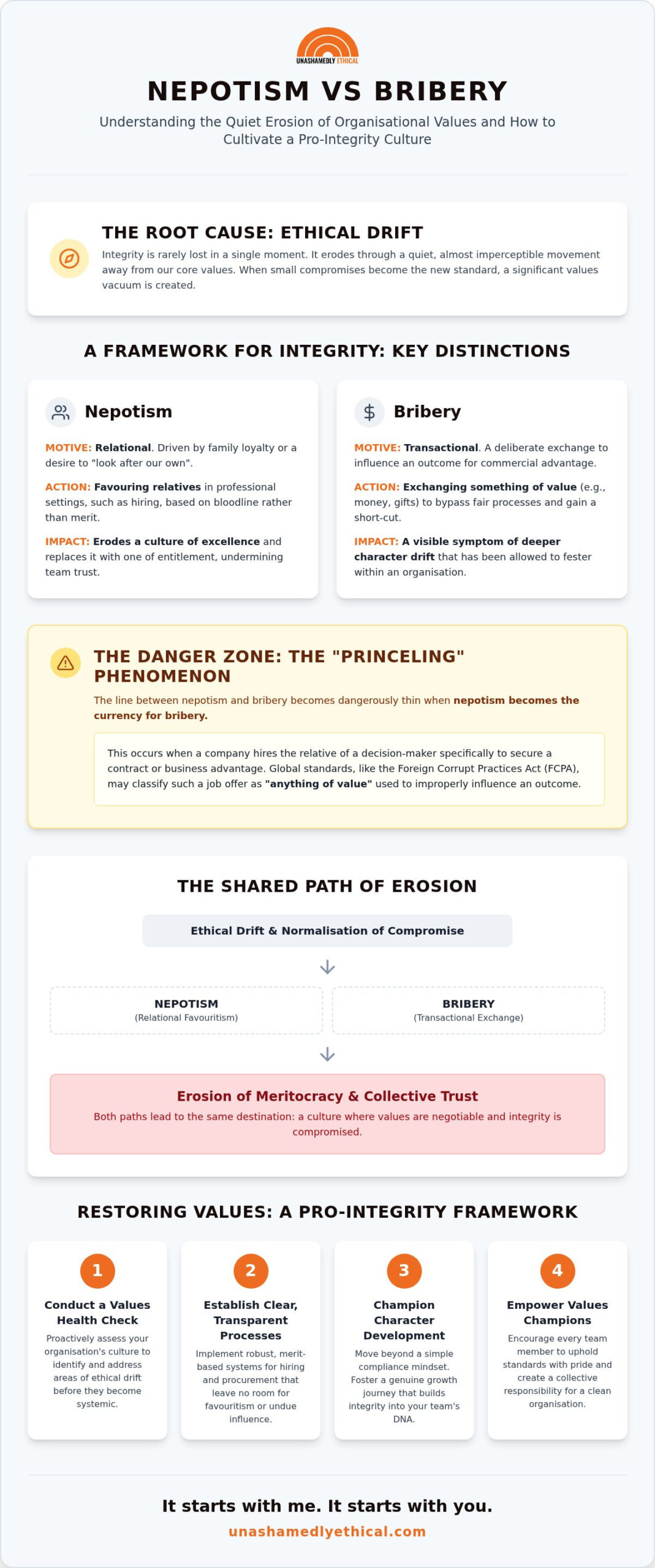
Understanding the crossover between these two behaviours is essential to protect the moral fabric of our organisations. To differentiate between nepotism and bribery, we must first look at the motive. Nepotism is relational; it is the “favoured son” receiving a role because of a blood tie. Bribery is transactional; it is the “greased palm” where something of value is exchanged to bypass fair process. Whilst they look different on the surface, they both share a common root in ethical drift. They replace merit with influence and excellence with favouritism.
The line becomes dangerously thin during the “princeling” phenomenon. This occurs when a company hires the relative of a decision-maker specifically to secure a contract or a business advantage. In this scenario, the act of nepotism becomes the currency for bribery. Global standards, such as the Foreign Corrupt Practices Act (FCPA), recognise this crossover. They often classify job offers to family members as “anything of value” when used to improperly influence an outcome. Recognising this helps us maintain a higher standard of character development across our teams.
To further protect your organisation during complex financial and investment programmes, you can discover Swiss Alpha Matrix for specialised due diligence and independent advisory services.
Key Distinctions in Intent and Outcome
Nepotism often begins with an “innocent” desire to support a loved one, yet it quickly creates a values vacuum. Bribery is usually a more calculated exchange. Both paths lead to the same destination: the erosion of meritocracy. When we choose favour over fitness for a role, we signal to our entire organisation that our values are negotiable. You can begin your own growth journey by choosing transparency in every recruitment decision you make.
The Legal and Ethical Intersection
In the South African context, the Prevention and Combating of Corrupt Activities Act (PRECCA) identifies these actions as corrupt activities. Section 34 creates a duty to report such behaviours, but we should view this as more than a legal burden. It is a collective responsibility to build a clean nation. Pro-integrity systems prevent both nepotism and bribery by establishing clear, transparent processes; to help manage these, you can explore Workflow Optimisation SaaS Solution to ensure every values champion can uphold them with pride. It starts with me; it starts with you.
Restoring Values: How to Interrupt the Normalisation of Compromise
Transformation is more than a goal; it’s a commitment to our shared future. We interrupt the normalisation of compromise by choosing the Ethics in Action pathway, a framework designed to institutionalise values health within the soul of an organisation. As we learn to differentiate between nepotism and bribery, we move from a state of passive compliance to active character formation. This process requires a courageous look at our daily choices and a willingness to address subtle drifts before they become systemic failures. It starts with me; it starts with you.
Practical Steps for Values Champions
A values champion doesn’t wait for a crisis to act. They proactively cultivate a pro-integrity atmosphere where every team member feels empowered to speak the truth. Whilst frameworks like the U.S. Federal Law on Nepotism provide high-level guidance for public service, private organisations must also build their own robust standards. You can start this process today by:
- Conducting a thorough values health check to pinpoint where drift might be occurring in your recruitment or procurement processes.
- Implementing a clear code of character that explicitly defines how your organisation handles family and friend relationships in a professional context.
- Creating a space where “Let’s Talk Ethics” becomes a monthly dialogue, ensuring that integrity is a living conversation rather than a dusty policy manual.
Starting Your Growth Journey
The path to restoration is a collective movement. Through Transformational Leadership on Demand (TLOD), leaders focus on the character formation necessary to stop individual drift in its tracks. When you differentiate between nepotism and bribery effectively, you protect the meritocracy that allows your people to flourish. We invite you to explore the Ethics in Action Business Consultancy to build your own roadmap to corporate integrity. Every signature on our Ethical Commitment is a bold declaration of a better way forward. It’s time to join a global community dedicated to excellence. It starts with me. It starts with you.
A Shared Commitment to Excellence
For over 15 years, our movement has been grounded in the legacy of Graham Power, providing practical, values-based frameworks for leaders who refuse to settle for the status quo. You have the power to transform your organisational culture from one of quiet compromise to one of bold integrity. We invite you to Sign the Unashamedly Ethical Commitment today and join thousands of others who are dedicated to this growth journey. Together, we can build a world where character is the foundation of every success. It starts with me. It starts with you.
Frequently Asked Questions
Is nepotism always illegal in South Africa?
Nepotism is not a standalone criminal offence in the South African private sector, but it often violates the Labour Relations Act and constitutional principles of fairness. Within the public sector, it is strictly prohibited by the Code of Conduct for Public Servants. To truly differentiate between nepotism and bribery, one must look at the intent; if a relative is hired specifically to secure a contract, this falls under the corrupt activities defined by the Prevention and Combating of Corrupt Activities Act (PRECCA).
What is the main difference between nepotism and cronyism?
The primary distinction lies in the nature of the relationship: nepotism involves favouring family members, whilst cronyism involves favouring friends or long-standing associates. Both behaviours are symptoms of ethical drift that replace merit with personal loyalty. Choosing a “crony” over a qualified candidate creates the same values vacuum as hiring a relative, as both actions undermine the collective pursuit of excellence and fairness within the organisation.
Can a small gift be considered bribery if it is a cultural norm?
Yes, even a small gift can be classified as bribery if the intent is to improperly influence a professional outcome. Whilst some cultures view gift-giving as a standard courtesy, pro-integrity organisations recognise that “anything of value” can be used as a shortcut to bypass fair process. It’s essential to maintain a clear code of character that distinguishes between genuine appreciation and a transactional exchange designed to gain an advantage. Intent is the defining factor in every values health check.
How does ethical drift lead to bribery in an organisation?
Ethical drift leads to bribery by slowly lowering the moral threshold of an organisation until compromise feels normal. It starts with a leader overlooking a small policy breach or a minor act of favouritism, which eventually expands into a culture where transactional shortcuts are accepted. When you fail to differentiate between nepotism and bribery early on, you allow a slide toward systemic corruption. This is why we advocate for a consistent growth journey to interrupt this slide. It starts with me; it starts with you.

Article by
Ilene Power
Ilene Power is the Chief Operating Officer and Ethics Officer of Unashamedly Ethical NPC, a South African organisation and global movement promoting ethical leadership, integrity, governance, and values-based decision-making. She is an Advocate of the High Court of South Africa, a Certified Ethics Officer, and a governance professional with more than 23 years of experience in employment law, corporate governance, organisational ethics, leadership development, and workplace culture.
Ilene advises businesses, boards, executives, and non-profit organisations on ethics, compliance, governance, whistleblowing, ethical culture, leadership accountability, and organisational integrity. She is the founder of **Ethics in Action**, Unashamedly Ethical's practical ethics consultancy, which helps organisations embed ethical leadership and build cultures of trust.
A recognised keynote speaker and thought leader, Ilene writes extensively on ethics, governance, leadership, workplace ethics, anti-corruption, psychological safety, speak-up culture, organisational trust, and responsible business. Her articles combine legal insight with practical guidance, helping leaders and organisations make ethical decisions that strengthen governance, build trust, and create sustainable impact.
Disclaimer
The information contained in this publication is provided by Unashamedly Ethical NPC for general information, educational and awareness purposes only. While every effort is made to ensure the accuracy of the information at the time of publication, the content does not constitute legal, professional or other specialist advice and should not be relied upon as a substitute for obtaining appropriate independent advice. The views expressed are intended to encourage ethical reflection and constructive dialogue. Unashamedly Ethical NPC accepts no liability for any loss or damage arising from reliance on the information contained herein.